
 —————————————————————–
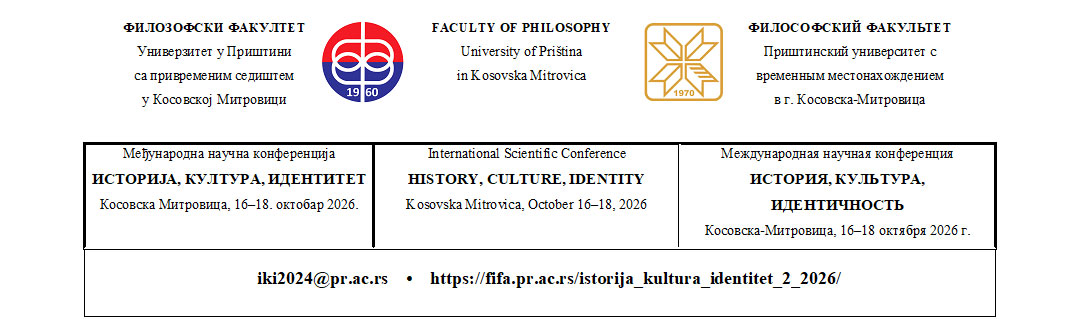
International Scientific Conference
HISTORY, CULTURE, IDENTITY 2
Kosovska Mitrovica
October 16–18, 2026
iki2024@pr.ac.rs
https://fifa.pr.ac.rs/istorija_kultura_identitet_2_2026/
—————————————————————–
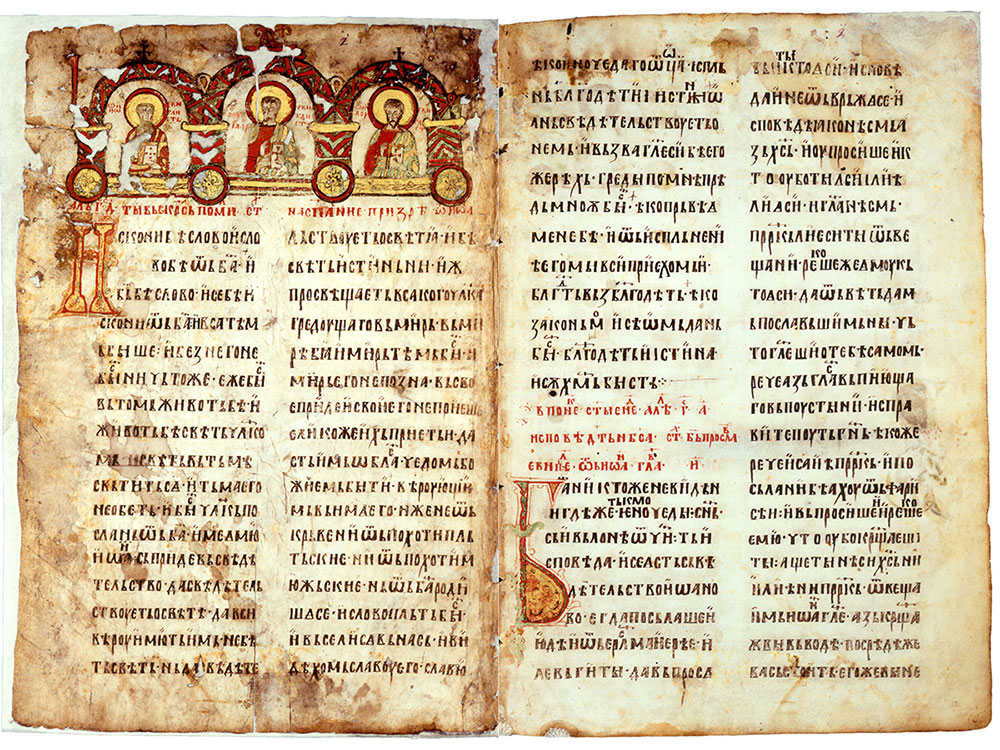
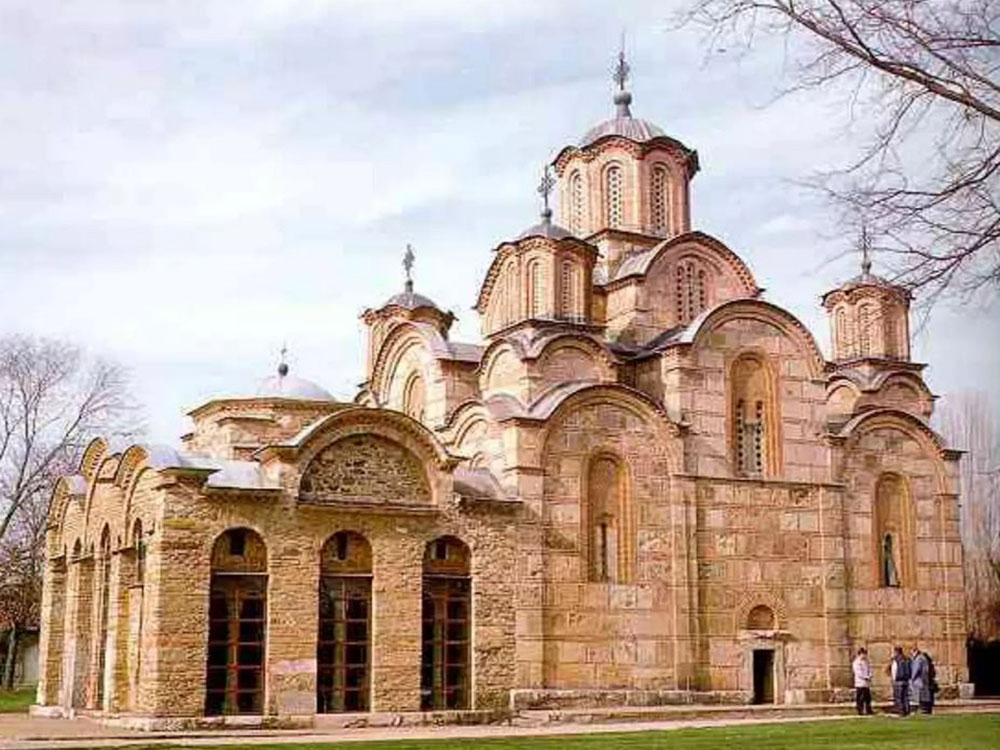

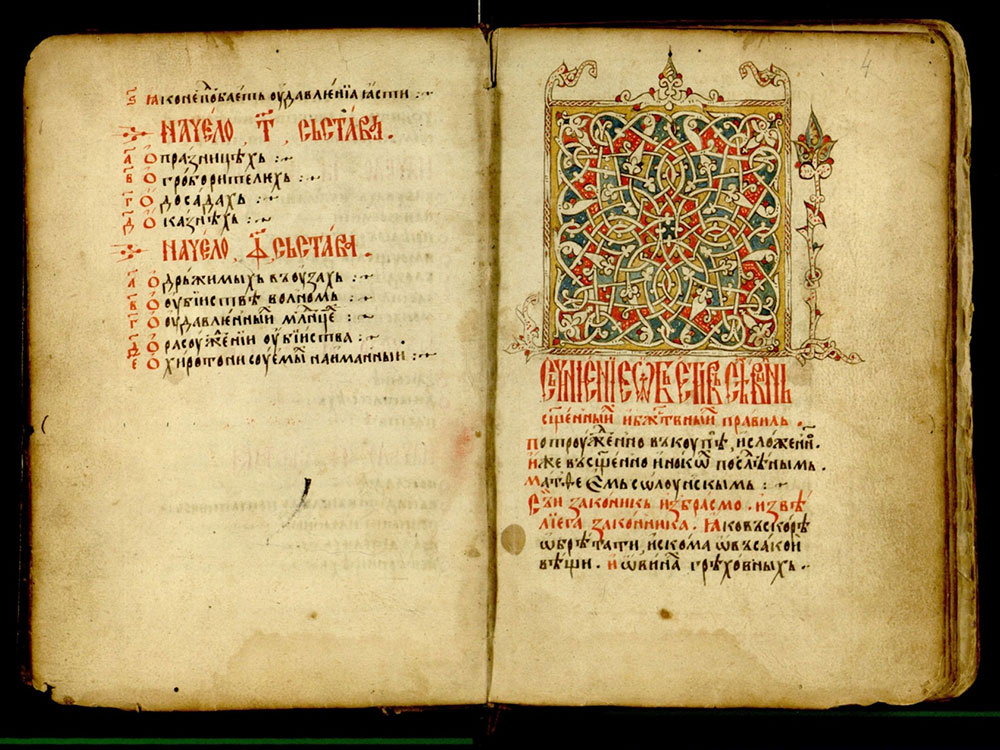
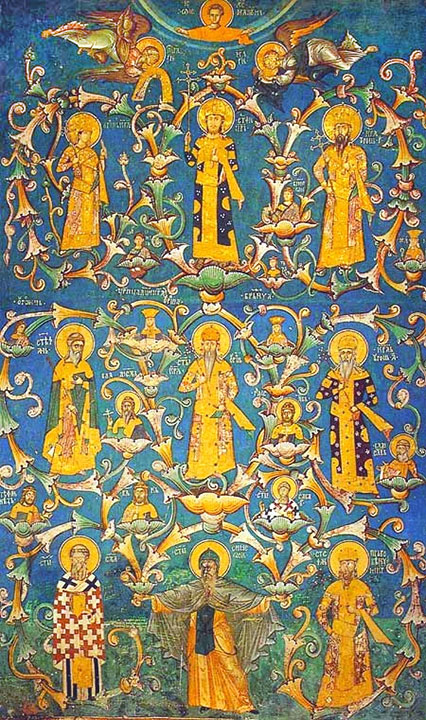
The Faculty of Philosophy of the University of Priština in Kosovska Mitrovica organizes an international scientific conference entitled History, Culture, Identity 2 (IKI 2) which will be held in Kosovska Mitrovica on October 16–18, 2026. The conference aims to discuss, elucidate, explore, and problematize various issues within the domains of history, culture, and identity through an interdisciplinary and multidisciplinary approach (incorporating insights from linguistics, literature, history, art history, philosophy, psychology, pedagogy, sociology, law and economics) and to examine the complex interrelations and connections between these domains and other societal phenomena.
The interdependence of historical processes, cultural changes, and mechanisms of identity development shapes how individuals interpret past events, adapt to social norms, and attain self-awareness within a socio-cultural context. Exploring identity development from contemporary perspectives and understanding how identity relates to different forms of the psychosocial functioning of an individual and society will be key objectives of psychological research. By thoroughly analyzing historical processes, events, and phenomena, the historiographical approach will answer numerous questions regarding the past, identify potential causes of current issues, and help avoid new challenges in the future. From the perspective of art history and utilizing innovative methodological approaches alongside interdisciplinary academic dialogue, art will be explored as an integration of cultural, political, and social norms, reflecting the distinct characteristics of various social groups and societies across different historical periods and regions. Sociology regards identities as individual and collective, always existing in an interplay of I – You and Us – Them dynamics, where identities represent positive attributes and stigmatizing features. The issue of identity has never been more scrutinized than in the modern era of globalization, leading to the development of comprehensive theoretical narratives with practical consequences in areas such as collective identity (e.g., nation-building, state-building) and individual identity (e.g., gender issues). In an era marked by identity crisis, the end of history, and the prevalence of subcultural behaviour patterns, philosophical research aims to rethink the dialectical relationship between history, culture, and identity, articulating the constants in change, the absolutes in history, and the essentials in identity. From the pedagogical theory and practice perspective, research into numerous educational concepts will contribute to developing national, cultural, scientific, humanistic, and democratic values in contemporary society, thereby enhancing the educational process. Linguistic research will focus on portraying language changes that occur over time due to the dynamic nature of societies and the current and historical events that shape them. Additionally, history, culture, and identity will be interpreted through various literary aspects, demonstrating how literary works illuminate the complexity of human experience, social norms, and individual and collective identities. Law will address the role of legal systems, institutions, and normative frameworks in shaping and protecting various forms of individual and collective identity, as well as the significance of legal regulation in structuring social relations within the context of cultural and historical change. From an economic perspective, attention will be given to the influence of economic processes, development policies, and institutional frameworks on the formation of cultural patterns and identity structures, as well as to the interdependence between economic development, social transformations, and the preservation of cultural heritage.
Recognizing your expertise in the aforementioned fields, we extend a warm invitation for you to contribute to the success of this international scientific conference through your scholarly research.
Plenary speakers
We are pleased to announce the plenary presentations of the following distinguished professors:
- Aleksandar Milanović, University of Belgrade, Faculty of Philology, Department of Department of Serbian Language with South Slavic Literatures, Belgrade (Serbia)
- Draga Mastilović, University of East Srajevo, Institute of Historical Sciences, Pale (Republic of Srpska)
- Zoran Matevski, Ss. Cyril and Methodius University, Faculty of Philosophy, Institute of Sociology, Skopje (North Macedonia)
Each plenary presentation will be allotted 30 minutes, including a ten-minute discussion.
Conference languages
The working languages of the conference are Serbian, Russian, and English.
Abstract submission and registration
Applications for participation must be submitted no later than May 25, 2026, using the online form:
Пријавни образац – Application Form – Образец заявки на участие
Please specify in the form whether you will be presenting onsite or online.
Presentations must be at most 15 minutes.
Each author may participate in a single presentation as the primary or co-author. A maximum of two authors per submission is permitted.
Notification of acceptance will be sent by June 5, 2026.
Conference fee
The registration fee per author is 6,000 RSD for participants from Serbia and 50 EUR for participants outside Serbia. The conference registration fee includes: attendance at conference sessions, conference materials, book of abstracts, proceedings, accommodation, food, refreshments, formal dinner, and excursion (visit to monasteries).
Payment instructions will be provided after the abstracts are accepted.
Conference publications
The Book of Abstracts will be published before the conference.
Full papers must be submitted by February 1, 2027. All papers accepted by two reviewers will be published in thematic proceedings.
The participants will be informed in due course about the conference programme, accommodation, gala dinner, a visit to the monasteries of Kosovo and Metohija (scheduled for the third day of the conference), etc.
For further details and announcements, please visit the website of the conference at: https://fifa.pr.ac.rs/istorija_kultura_identitet_2_2026/
If you need further assistance, reach out to our Organizing Committee at iki2024@pr.ac.rs
We look forward to meeting you at the conference.
The Organizing Committee
History, Culture, Identity 2
| I M P O R T A N T D A T E S | |
| Conference: | 16–18 October 2026 |
| Abstract submission deadline: | 10 May 2026 |
| Abstract acceptance notification: | 20 May 2026 |
| Full paper submission deadline: | 1 February 2027 |
PROGRAMME COMMITTEE
- Prof. Aleksandra Kostić Tmušić, University of Priština in Kosovska Mitrovica, Faculty of Philosophy, Department of Serbian Literature and Language, Kosovska Mitrovica (Serbia); President of the Committee
- Prof. Zvezdan Arsić, Dean, University of Priština in Kosovska Mitrovica, Faculty of Philosophy, Department of Pedagogy, Kosovska Mitrovica (Serbia)
- Prof. Dragana Stanojević, University of Priština in Kosovska Mitrovica, Faculty of Philosophy, Department of Psychology, Kosovska Mitrovica (Serbia)
- Assoc. Prof. Dr. Snežana Zečević, University of Priština in Kosovska Mitrovica, Faculty of Philosophy, Department of English Language and Literature, Kosovska Mitrovica (Serbia)
- Assoc. Prof. Dr. Branislava Dilparić, University of Priština in Kosovska Mitrovica, Faculty of Philosophy, Department of English Language and Literature, Kosovska Mitrovica (Serbia)
- Prof. Miloš Kovačević, University of Kragujevac, Faculty of Philology and Arts, Department of Philology, Kragujevac (Serbia)
- Prof. Draga Mastilović, University of East Sarajevo, Institute of Historical Sciences, Pale (Republic of Srpska, Bosnia and Herzegovina)
- Prof. Radmilo Marojević, University of Belgrade, Faculty of Philology, Department of Slavic Studies, Belgrade (Serbia)
- Prof. Vladimir Boranijašević, University of Priština in Kosovska Mitrovica, Faculty of Law, Kosovska Mitrovica (Serbia)
- Prof. Srđan Lalić, University of East Sarajevo, Faculty of Economics Brčko, Department of Accounting and Finance, Brčko (Bosnia and Herzegovina)
- Prof. Vesna Lopičić, University of Niš, Faculty of Philosophy, Department of English, Niš (Serbia)
- Prof. Aleksandar Milanović, University of Belgrade, Faculty of Philology, Department of Serbian with South Slavic Languages, Belgrade (Serbia)
- Prof. Uroš Šuvaković, University of Belgrade, Faculty of Education, Department of Philosophy and Social Sciences, Belgrade (Serbia)
- Prof. Zoran Matevski, Ss. Cyril and Methodius University, Faculty of Philosophy, Institute of Sociology, Skopje (North Macedonia)
- Prof. Miodrag Jovanović, University of Montenegro, Faculty of Philology, Department of Serbian Language and South Slavic Literature, Nikšić (Montenegro)
- Prof. Slavko Petaković, University of Belgrade, Faculty of Philology, Department of Serbian with South Slavic Literatures, Belgrade (Serbia)
- Prof. Jelica Stojanović, University of Montenegro, Faculty of Philology, Study Programme of Serbian Language and South Slavic Literature, Nikšić (Montenegro)
- Prof. Georgios Nektarios Lois, Hellenic Open University, School of Humanities, Study Programme of Orthodox Christian Theology and Religious Pluralism Studies, Patras (Greece)
- Prof. Serhii Lehenchuk, Zhytomyr Polytechnic State University, Faculty of Business and Services, Department of Information Systems in Management and Accounting, Zhytomyr (Ukraine)
- Prof. Natalya Borisovna Lapayeva Risteska, Perm National Research Polytechnic University, Department of Foreign Languages and Public Relations, Perm (Russia)
- Assoc. Prof. Gürbüz Arslan, Zonguldak Bülent Ecevit University, Zonguldak (Turkey)
- Prof. Slobodan Vladušić, University of Novi Sad, Faculty of Philosophy, Department of Serbian Literature, Novi Sad (Serbia)
- Prof. Dr. Andreas Bernecker, FH Aachen – University of Applied Sciences, Department of Business, Aachen (Germany)
- Prof. Milanko Govedarica, University of Belgrade, Faculty of Philosophy, Department of Philosophy, Belgrade (Serbia)
- Asst. Prof. Simon Malmenvall, University of Ljubljana, Faculty of Theology, Ljubljana (Slovenia)
- Assoc. Prof. Ljiljana Jerković, University of Banja Luka, Faculty of Philosophy, Study Programme of Pedagogy, Banja Luka (Republic of Srpska, Bosnia and Herzegovina)
- Prof. Biljana Milošević Šošo, University of East Sarajevo, Faculty of Philosophy, Department of Sociology, Pale (Republic of Srpska, Bosnia and Herzegovina)
- Assoc. Prof. Milica Mitrović, University of Niš, Faculty of Philosophy, Department of Psychology, Niš (Serbia)
- Prof. Slađana Zuković, University of Novi Sad, Faculty of Philosophy, Department of Pedagogy, Novi Sad (Serbia)
- Prof. Dmitar Tasić, Principal Research Fellow, The Institute for Recent History of Serbia, Belgrade (Serbia)
- Assoc. Prof. Dragana Novakov, State University of Novi Pazar, Department of Philological Science, Study Programme of Serbian Literature and Language, Novi Pazar (Serbia)
- Prof. Tatjana Novović, University of Montenegro, Faculty of Philosophy, Department of Pedagogy, Nikšić (Montenegro)
- Prof. Athanasios Semoglou, Aristotle University of Thessaloniki, School of History and Archeology, Department of History and Archeology, Thessaloniki (Greece)
- Assoc. Prof. Anna Zakharova, Lomonosov Moscow State University, Faculty of History, Department of History and Theory of Art, Moscow (Russia)
- Prof. Stavros Mamaloukos, University of Patras, Polytechnic School, Department of Architecture, Patras (Greece)
- Assoc. Prof. Nataša Nikolić, University of Belgrade, Faculty of Philosophy, Pedagogy Study Group, Belgrade (Serbia)
- Asst. Prof. Milena Belić, State University of Novi Pazar, Department of Philosophy and Arts, Study Programme of Psychology, Novi Pazar (Serbia)
- Asst. Prof. Inga Jēkabsone, Riga Technical University, Faculty of Engineering Economics and Management, Riga (Latvia)
ORGANIZING COMMITTEE
- Assoc. Prof. Tatjana Kompirović, President of the Committee
- Prof. Brankica Popović
- Prof. Jelena Mihajlović
- Prof. Saša Stanojević
- Prof. Tatjana Radojević
- Prof. Ana Andrejević
- Assoc. Prof. Maja Pavlović Šajtinac
- Assoc. Prof. Ivan Stojilović
- Asst. Prof. Branislava Vučković
- Asst. Prof. Aleksandar Kostadinović
- Asst. Prof. Nebojša Stanković
- Dr. Aleksandra Dimitrijević, Assistant with PhD
- Dr. Nataša Ninčetović, Teaching Assistant
- Dr. Anica Radosavljević, Teaching Assistant
- Milica Marjanović, Teaching Assistant
- Mitar Nedeljković, Teaching Assistant
- Tamara Dobrić, Teaching Assistant
- Luka Jovanović, Teaching Assistant
- Tijana Simić, Teaching Assistant
- Vasilije Stoiljković, Senior Lecturer
- Jovana Tomašević, Teaching Associate